Giovanni Otero
One of the major bi-products of rampant mobile phone usage is the inherent waste associated with them. Each one of these devices relies on a power supply consisting of rechargeable lithium battery packs. This technology makes it very convenient for the user to travel and replenish power to their device simply and easily as long as a sustainable AC voltage source is present. The mobile phone market is advancing so quickly that these devices are often short lived with users constantly yearning for a newer model with more features. Older models are seldom kept; instead they are thrown away with their lithium battery packs rarely recycled properly. These batteries are comprised of a slew of highly toxic chemicals and heavy metals; ending up in landfills these lithium batteries can wreak havoc on the environment as well as the ozone layer.
Lithium battery contents are a combination of many different types of elements including heavy metals and plastics. The majority of the chemical elements inside of lithium batteries are classified as toxic by the United States Environmental protection agency. Land filling and improper disposal of lithium batteries can cause detrimental effects to the environment as well as pose potential health risks to humans and animals that come into contact with them. The highly toxic materials contained in the batteries often do not mix well with each other and cause additional pollutants to the environment when undergoing recycling treatment. These factors pose a great challenge to recycling manufacturers when processing these volatile materials due to risks of exposure in the work place as well as the potential to spontaneously combust, ultimately causing violent explosions and fires in recycling facilities.
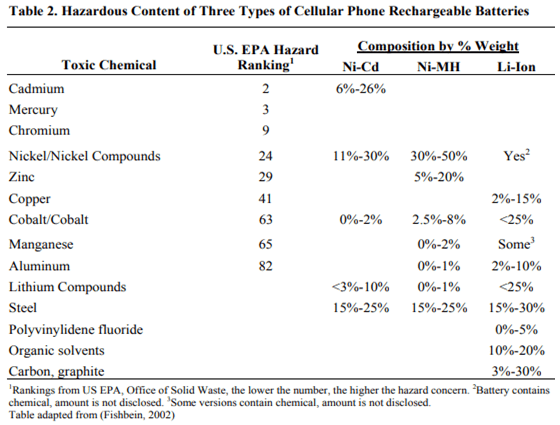
This chart expresses the vast amount of toxic elements that are contained in lithium batteries (Kang, Daniel Hsing Po). According to The International Agency for Research on Cancer, many of these chemical compounds are considered carcinogenic and can cause severe impacts to overall health when exposed to in the work place. Not only are the chemicals found in lithium batteries toxic in their own state, it becomes an even greater issue when these chemicals undergo recycling treatments which ultimately release carbon emissions further damaging the atmosphere. Environmental damage is an unfortunate result in the current forms of lithium battery recycling process that exist today. This begs the question; are mobile phones really the saving grace of our generationor are there impacts causing more harm than good?
Lithium batteries often do not have its chemical elements listed on them, which makes the recycling process more difficult when transporting lithium batteries to a recycling plant. Explosive reactions can result if these chemicals become exposed to air or mix with other chemicals, again adding to the complexity involved in recycling these batteries. Sorting electronics from trash after they are disposed of is an arduous as well as costly task, forcing companies to lean toward stock piling or land filling over recycling of lithium batteries. A staggering 95% of lithium-ion batteries end up being land filled or stock piled at the end of their life cycle (ColdFusion). This poses a hazard to the environment due to the heavy metals leaking toxic particles into the soil causing higher global warming potentials from CO2 emissions released from the decaying materials. Even the recycling process releases carbon emissions because of such a large amount of plastics that make up many types of lithium batteries. The intense heat from pyrometallurical processes in recycling causes out gassing of plastics, increasing global warming potentials and inadvertently harming the atmosphere.
The overall focus of lithium battery waste due to mobile phone usage should not be whether or not to recycle them, but instead precisely when to recycle them. Lithium batteries inside electronics and specifically mobile phones still have a large percentage of usability even after being deemed unusable for their respective applications. Studies find that Lithium batteries still obtain 70% of their state of health remaining before disposal and recycling (Amrit Chandan). This is a tremendous waste as these batteries have usage potential for other types of energy storage applications. Further use of these batteries in other applications until an entire depletion of the battery packs energy occurs could mitigate harmful CO2 emissions that are a direct result of the wasted lithium batteries that are dumped when mobile phones are discarded. If waste batteries could be used for a longer period of time, even the unavoidable pollution caused by the recycling processes could be reduced by a large amount. Battery and electronics manufacturers are starting to catch on to this idea and implementing creative ways to extend the use of waste lithium batteries. The media has done much to inform people of the negative impacts of mobile phone usage. A good combative measure to keep these negative by products associated with mobile phone use down is a more informed society. Mobile phone use is here to stay, safer ways to recycle these devices and manage time consumption when indulging in there usage is dependent on societies ability to educate each other on the inherent dangers encompassing their use and consumption. There is no doubt that excessive mobile phone use can do harm not only physically and psychologically but also environmentally. The damages it can cause can lead to many dangerous and unhealthy situations to occur. Just like what were stated on the many researches and studies made, it can lead to anxiety and depression as well as severe headaches and unhealthy way of living. On top of that, they are also a huge threats to our environment. For these reasons, using mobile phones is not bad at all but excessive usage do more harm than good.
 Giovanni and Jaymel's blog